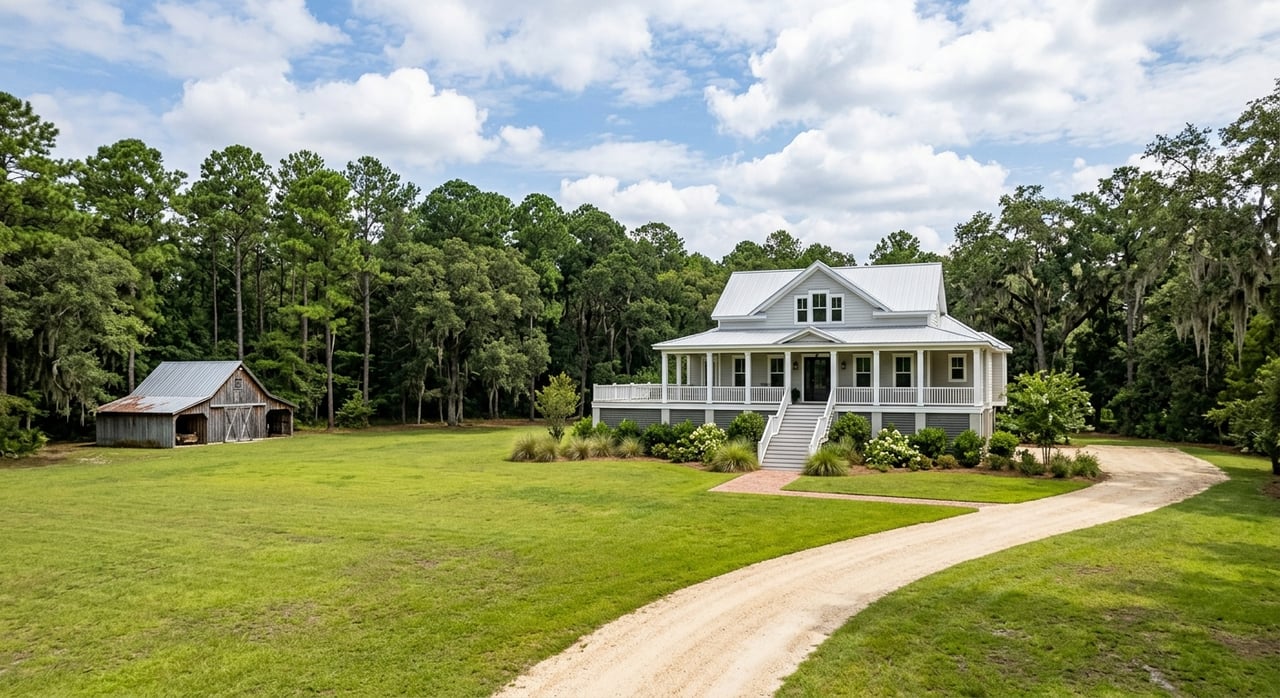
Buying land sounds simple until you realize the real question is not just how many acres, but what those acres can actually do for you. If you are considering acreage in Elberta, you are likely weighing privacy, future flexibility, and long-term value all at once. The good news is that Elberta offers a mix of rural character, practical access, and a range of parcel types that can fit different goals. Let’s dive in.
Why Elberta appeals to land buyers
Elberta sits in southern Baldwin County, with U.S. 98 running through town and connecting west to Foley and east to Lillian near the Florida line. That location gives you an inland option within the broader Foley and coastal Baldwin County corridor, rather than a fully isolated rural setting. For many buyers, that balance is a big part of the appeal.
The town also points to farming-centered roots, with the area historically promoted for rich soil and year-round farming conditions. Today, that heritage still shows up in the land mix. You will find rural tracts, homesites, and parcels with future development potential alongside more compact residential and business areas.
A look at Elberta’s zoning map supports that variety. Outer areas often show R-A zoning, while other parts of town include residential, business, industrial, and planned development districts. In practical terms, that means two parcels with similar acreage can have very different use paths and value.
Start with location and jurisdiction
Before you focus on price per acre, confirm whether a parcel is inside Elberta town limits or under Baldwin County jurisdiction. That step matters because zoning, approvals, and development rules may differ depending on where the property falls. Baldwin County notes that its parcel viewer and zoning verification portal are the current references for confirming zoning, and maps may not always reflect the most recent rezoning actions.
This is one of the most important early checkpoints because it shapes everything that follows. Your utility options, subdivision path, permit process, and land-use approvals may depend on whether the town or county controls the parcel. If you skip this step, you risk underwriting the property on the wrong assumptions.
Know the zoning before you buy
R-A land in Elberta
For acreage buyers, the R-A Rural Residential Agricultural District is often the most relevant zoning category. This district is intended for large, open, unsubdivided land used for agricultural, forest, or other rural purposes. The minimum lot area is 80,000 square feet, which is about 1.8 acres, and the minimum lot width is 150 feet.
If you are looking for a homesite with elbow room, mini-farm potential, or a tract you want to hold over time, R-A land may align well with your goals. Still, you should not assume that every large parcel offers the same flexibility. Frontage, utilities, and approval requirements still matter.
R-1 and higher-density districts
R-1 is a lower-density single-family district, but the minimum lot size changes based on utility availability. The minimum is 40,000 square feet with septic and well, or 15,000 square feet where septic is paired with public water or where both public water and sewer are available. That tells you something important right away: utilities can materially affect development potential.
R-3 represents a higher-density residential district and is tied to public or community water and sewer facilities. If you are comparing land for a future building strategy, utility access can be just as important as zoning labels. A parcel with stronger utility support may underwrite very differently from a larger tract that depends on septic and more extensive approvals.
Access can make or break a land purchase
Acreage buyers often focus on boundaries and total size, but legal access deserves equal attention. Elberta’s ordinance requires frontage on a public street with a right-of-way of at least 60 feet for each principal use, unless an existing right-of-way is already narrower. For additional dwellings, access must include a 15-foot-wide passageway open to the sky.
That means a parcel that looks attractive on paper may still have limitations if access is unclear or insufficient. Road frontage, right-of-way width, and driveway approval all affect how usable the property is today and how flexible it may be later. If the tract fronts a county road, driveway permits go through the county Highway Department, while state highway access requires ALDOT approval.
Lot shape and lot history matter too
Not every parcel that exists on a map is automatically build-ready under current rules. In Elberta, a lot of record may sometimes be used even if it does not meet current dimensions, but that exception is narrow. In a residential district, a single-family dwelling may be allowed on a nonconforming lot only if it has at least 4,000 square feet, a 40-foot building-line width, and public sewer.
There is another wrinkle for adjoining lots. If two or more adjoining vacant lots with continuous frontage are under single ownership and do not meet the district’s minimum frontage or area, they must be replatted or reparceled to create conforming lots. If you are buying multiple adjacent parcels, that rule can affect your strategy.
Existing rural use can carry value
One overlooked advantage in Elberta is that existing farmland under cultivation, pastureland, and timberland may continue to be used for those purposes regardless of zoning district. That helps explain why some tracts can retain a working-land or mini-farm character even as surrounding areas evolve. For buyers who value land with a more rural use profile, that continuity can be meaningful.
This does not mean every future use is automatic, but it does matter when you are evaluating how the property functions today. If the tract already supports a rural use you like, that existing pattern may add practical value beyond the raw acreage count.
Utilities shape both cost and potential
Elberta’s utility picture is not uniform, and that has a direct effect on land value. According to the town, Riviera Utilities serves power and gas to a large portion of the northern corporate limits and provides water to most of Elberta inside the corporate limits. Perdido Bay Water serves outlying areas east of the corporate limits, Baldwin EMC serves the southern part of CR 83 and the Miflin area, Orange Beach Sewer serves Miflin, and Baldwin County Sewer serves a large portion of the northern area inside the corporate limits.
For you, that means utility availability should be verified parcel by parcel. A tract with public water or sewer nearby may offer a shorter and clearer path to use. A parcel that depends on private systems may still work well, but the timeline, testing, and cost structure can look very different.
Septic and well questions to answer early
If a parcel is not connected to public sanitary sewer, Alabama law requires a permit from the local health department before a new onsite sewage system is installed or an existing one is repaired. The Alabama Department of Public Health also notes that some lots are not suitable for onsite sewage disposal and should be evaluated early by a registered professional. That makes septic feasibility one of the first items to investigate.
Private well questions deserve early review too. ADEM does not regulate or test individual private wells and recommends contacting the local health department or certified labs for well-water concerns. If your plan depends on private water, make sure that part of your due diligence is realistic and well-timed.
Flood review is a major underwriting factor
In Baldwin County, floodplain review is a serious part of evaluating land. The county’s floodplain ordinance applies inside Elberta and requires special review in flood hazard areas. In A, AE, AH, AO, and A-1 through A-30 zones, elevation documentation is required before permits are issued, and work in a floodway can require a no-rise certificate.
This is one of the clearest examples of why acreage value is about more than size. A beautiful tract with flood-related constraints may still be useful, but it could involve added time, engineering, and cost. Before you make an offer, confirm the parcel’s flood status and ask what that means for permits and site planning.
Land disturbance can add cost
If your plans involve substantial site work, there may be another layer to review. Baldwin County says ADEM’s NPDES general permit is required if land disturbance will exceed one acre. The county also notes that unzoned land disturbance in a special flood hazard area or potential wetland area must be approved before a building permit can be issued.
For acreage buyers, those are not small details. Clearing, grading, and drainage work can change the economics of a property quickly, especially if the parcel needs engineered solutions before vertical construction can begin.
Understand the approval path before you offer
Elberta’s land-use checklist requires several items that can affect timeline and cost. Depending on the project, you may need a site or property layout plan, utility release forms, electronic blueprints, right-of-way permits for new drives, an addressing letter from 911 addressing, and HOA or POA approval when applicable. For commercial, multifamily, and public-building projects, engineered site plans are required.
The town also states that construction permitting is not processed without Planning Commission approval of the site plan when required, and the Baldwin County Building Department issues building permits and inspections after land-use approval. If your vision for the land goes beyond a simple homesite, it is smart to map the approval path before you negotiate price.
When land becomes a development tract
Some acreage is best suited for a private homesite, while some may be evaluated as a future development parcel. In Elberta, uses requiring Planning Approval or Council Approval are reviewed for access, water supply, waste disposal, fire and police protection, traffic, and compatibility with the district. For certain uses, including commercial, multifamily, RV park, mobile home park, hotel, and motel uses, the town requires a site plan prepared by an Alabama-registered engineer and the application must be filed 15 business days before the meeting.
For parcels outside town limits, Baldwin County rules may apply instead. The county notes that some areas are unzoned, and subdivision rules can still come into play. A Planned Residential Development may allow variations in lot sizes, widths, setbacks, and building height, but subdivisions still must follow the county plat process.
If you hope to divide land later, that issue should be addressed up front. Baldwin County says sketch plan review is required for subdivisions with six or more lots and new infrastructure, while certain family divisions, one-time historic splits, boundary adjustments, and some larger two-parcel splits may be exempt.
How to think about land value in Elberta
Vacant land value is not just a price-per-acre exercise. Appraisal guidance treats land as a highest-and-best-use question, meaning the most credible analysis considers what is physically possible, legally permissible, financially feasible, and maximally productive. That framework is especially useful in Elberta because parcel differences can be significant.
In practical terms, the biggest value drivers are usually the legal path to use, the utility path, the access path, and the entitlement path. A parcel with verified frontage, public water or sewer, limited flood complications, and a clear site-plan or subdivision route will typically underwrite differently from a tract that requires septic testing, flood mitigation, drainage engineering, rezoning, or platting work.
Comparable sales still matter, of course. But when vacant-land comparables are limited, broader analysis becomes even more important. Two similarly sized parcels may deserve very different pricing if one has a cleaner and faster path to use.
A practical due diligence checklist
Before you write an offer on acreage in Elberta, make sure you can answer these questions:
- Is the parcel inside Elberta town limits or under Baldwin County jurisdiction?
- What is the current zoning, and what uses are allowed now?
- Does the tract have verified public road frontage and legal access?
- Are public water, sewer, gas, or power available, and from which provider?
- If septic is needed, has the parcel been evaluated for onsite sewage suitability?
- Is any part of the property in a flood hazard area or floodway?
- Will clearing or grading trigger added approvals or permitting?
- If you want to divide the land later, what subdivision or platting rules apply?
- Does the property need engineered site plans, right-of-way permits, or other local approvals?
The more clearly you can answer those questions, the better you can judge whether the asking price reflects the property’s real potential.
Final thoughts on buying acreage in Elberta
Elberta gives you a compelling mix of rural space, practical access, and long-term flexibility in southern Baldwin County. But the strongest land purchases are usually not the ones with the most acreage on paper. They are the ones with verified access, a workable utility plan, and a clear route to the use you actually want.
If you are considering land in Elberta for a homesite, long-term hold, or future development, local due diligence matters. Working through zoning, utilities, flood review, and permitting before you buy can help you avoid surprises and move forward with more confidence.
If you want help evaluating acreage opportunities in Elberta and across Baldwin County, connect with Andrea Kaiser Shilston & Eva Wilmott for thoughtful, local guidance.
FAQs
What makes Elberta appealing for acreage buyers?
- Elberta offers an inland location within the Foley-to-coastal Baldwin County corridor, along with a mix of rural tracts, homesites, and parcels with future development potential.
What zoning matters most for acreage in Elberta?
- R-A Rural Residential Agricultural zoning is often the key district for acreage buyers because it is intended for large, open land used for agricultural, forest, or other rural purposes.
How do utilities affect land value in Elberta?
- Utility availability can materially change a parcel’s development potential, especially when comparing land that has access to public water or sewer with land that depends on private systems.
What should buyers know about septic for Elberta land?
- If a parcel is not connected to public sewer, Alabama requires a permit from the local health department for a new onsite sewage system or repairs, and some lots may not be suitable for onsite sewage disposal.
Why is flood review important for land in Elberta?
- Baldwin County’s floodplain rules apply inside Elberta, and parcels in certain flood hazard zones may require elevation documentation or other flood-related review before permits are issued.
Can you split acreage in Elberta or nearby Baldwin County later?
- Possibly, but the answer depends on whether the parcel is under town or county jurisdiction and whether subdivision, platting, sketch plan review, or an exemption applies.
What is one of the biggest mistakes buyers make with acreage in Elberta?
- A common mistake is focusing only on acreage size and price without first confirming zoning, access, utility availability, flood status, and the approval path for the intended use.