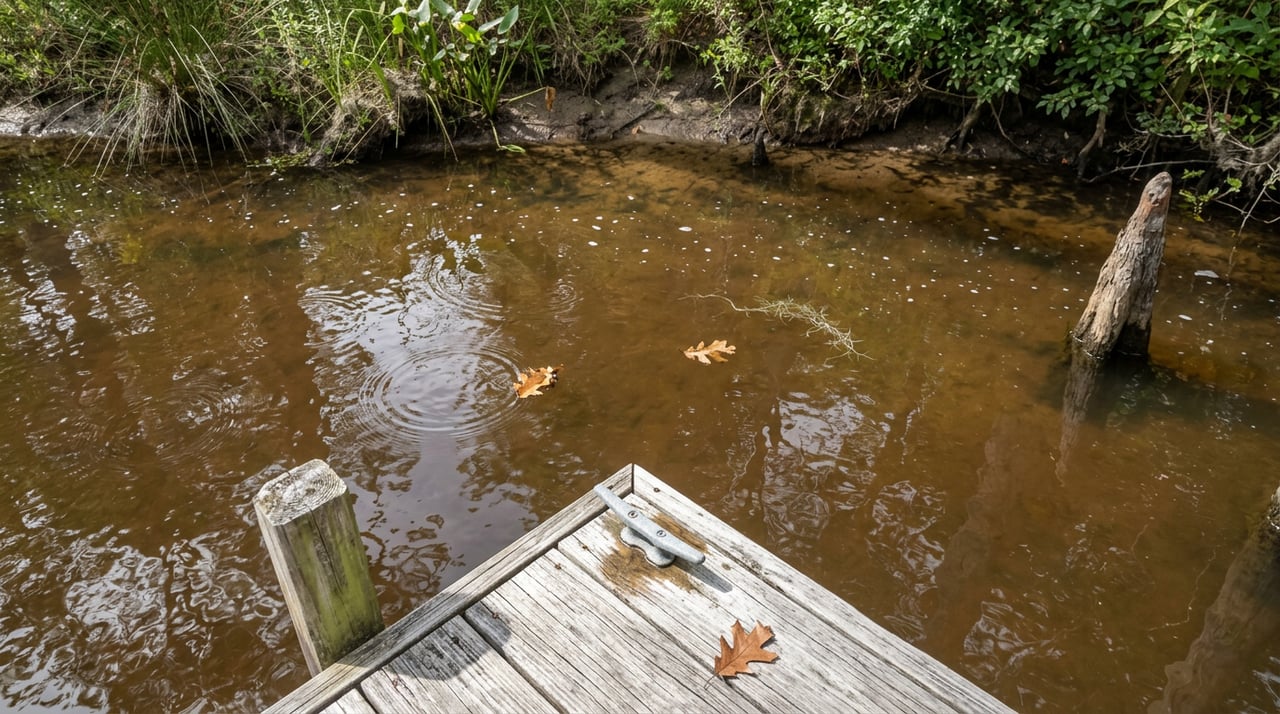
Past the County Road 49 bridge, where live oaks lean over the water and cypress knees break the surface near the bank, the Magnolia River slows into a spring-fed pocket locals call the Cold Hole. It has been the town's answer to a Baldwin County summer for generations: water cold enough to make you gasp, calm enough to float for an hour without paddling, close enough to Jesse's Restaurant that you can dry off and order a steak twenty minutes later. Nobody who grew up here needed a reason to trust it. You just went in.
This summer that trust got a number attached to it, and the number told a different story than anyone expected.
The Reading That Changed Before Independence Day
Mobile Baykeeper has tested the Cold Hole for years as part of its weekly SWIM report, alongside seventeen other sites around Baldwin and Mobile counties. The EPA's safe-swimming line sits at 104 Enterococci colonies per 100 milliliters of water, though Baykeeper staff scientist Cassie Bates notes freshwater sites can run a bit higher before real concern sets in. For most of its history, the Cold Hole simply did not test near that line. It tested clean, week after week, the kind of boring good news that never makes anyone look twice.
Gulf Coast Media reported that on June 27, the reading came back at 346, more than triple the safe threshold. Baykeeper staff figured it was a one-off, the kind of blip that follows a heavy rain. Five days later, on July 2, right before the town's busiest swimming weekend of the year, the number came back at 4,352.
That is not a fluctuation. That is about forty-two times the EPA's safe limit, at the one spot in town where a bad reading actually reaches people. Commenters on Baykeeper's July Facebook post floated theories, livestock runoff, an overflowing septic tank, but nobody has confirmed a cause. Since that spike, readings have stayed under 300, still elevated by historical Cold Hole standards but nowhere near the July 2 number. The mystery of what caused it remains open. What is not open to debate is how fast the town responded.
The Volunteers Who Beat Everyone Else To The Data
As Mobile Baykeeper reports, fifteen years ago, Magnolia Springs had its own water-testing group, part of the statewide Alabama Water Watch network. It went quiet for over a decade, one of those civic efforts that fades when the people running it move on. A resident named Turner brought it back in 2025 after following Baykeeper's SWIM reports and sitting in on a Wolf Bay Water Watch meeting. He had a biology and chemistry background he had never used professionally, and by his own account, no real experience running an environmental nonprofit. What he had was a reason to care about the watershed he grew up next to.
The group started with four volunteers. By March 2026, it had grown to fourteen certified testers, all trained through Alabama Water Watch's certification program, which requires hours of instruction before anyone is allowed to collect a sample that counts. This is not a group of neighbors eyeballing the water and guessing. Testers use salinity refractometers to check whether Mobile Bay's brackish water is pushing upriver, measure oxygen, pH, and turbidity at each site, then draw a final sample into sealed glass bottles that never touch air or bare hands before reaching Town Hall. There, the sample gets transferred with a sterilized pipette onto Roth Biochemical test cards, three per site, and left in an incubator for twenty-four hours before anyone reads a result.
The team now covers fourteen sites spanning roughly four miles of river, from near the headwaters down toward the mouth, testing monthly and reporting results to Alabama Water Watch, where anyone can look them up.
Town clerk Hannah Driskell is one of the fourteen. Her assigned spot is upriver at The Commons, close enough that she does not need a boat to reach it. She has lived in Magnolia Springs her whole life, and when she talks about the work, the reason is simple.
"I have lived in Magnolia Springs my whole life."
That line does a lot of work. This is not an outside agency parachuting in to monitor a town it does not know. It is the town's own clerk, standing at a stretch of river she has known since childhood, running the same test her neighbors run at thirteen other points along the same water.
An Old Habit Getting A New Backup
Magnolia Springs has trusted this river for longer than anyone alive can remember firsthand. Since 1916, the town has been home to the only year-round dock-to-dock mail route in the country, a 15-foot boat working its way to 176 mailboxes across roughly 31 miles of waterway. The route started because the roads were mud and the river was reliable. Today it is still running, piloted by Reid Cole, who has carried the mail here for a decade, following a path his great-uncle Claude Underwood ran by boat in the 1960s and 70s. It survives not because it is efficient but because the river has simply always been how this town connects to itself.
That is the same faith that sent generations of kids into the Cold Hole without a second thought. The mail boat and the swimming hole both run on the same assumption: this river is safe, this river is ours, this river does not need explaining.
Water Watch does not break that faith. It backs it up. For the first time in a decade and a half, Magnolia Springs has its own people checking the thing everyone already believed, at more points and more often than any single county or state agency would bother to on its own. Alabama Water Watch's data has already been used elsewhere to flag runoff problems, justify restoration funding, and inform zoning decisions before they become bigger fights. A town that can point to its own numbers is in a stronger position than one that has to wait on someone else's schedule.
Checking Before You Swim
Baykeeper samples the Cold Hole every Thursday during swimming season, April through September, and posts results by Friday on its public Swim Guide site. During the cooler months, testing drops to monthly. A few habits worth building into a summer routine here:
- Check the Cold Hole's status on Swim Guide before a swim, especially the day after heavy rain, since runoff has historically been the likely driver of spikes.
- Remember that a single bad week does not mean a spot is permanently unsafe. The Cold Hole tested clean for years before this summer's spike, and readings have already come back down.
- If you want the fuller picture, Alabama Water Watch's public data includes the fourteen additional sites the local volunteer team checks monthly, covering water conditions well beyond the one spot everyone floats at.
The Real Change This Summer
The headline out of this summer is not that one reading hit 4,352. Readings spike. Rivers respond to rain, runoff, and whatever is happening upstream on any given week. The actual news is that a town of a few thousand people rebuilt its own environmental monitoring group from four volunteers to fourteen trained testers in under a year, covering more of the river than it had in over a decade, and made the results public before anyone official had to ask.
Magnolia Springs has always run on the idea that the river takes care of itself and, by extension, takes care of the town. This summer showed that the town is no longer content to leave it at that. People who have swum this water their whole lives are now the ones measuring it, and that is a different kind of trust than the one the mail boat has been running on since 1916. It is trust with a number attached, checked monthly, by neighbors who live close enough to walk to their own testing site.
If you are watching how a place like Magnolia Springs handles the small things, the water, the mail, the habits that hold a town together, that says as much about its future as any listing ever could. The Legacy Group stays close to those details because they shape what it actually means to live along this stretch of the Gulf Coast. If you would like to talk about what is changing in Magnolia Springs or any of the communities nearby, Schedule a Private Consultation with Andrea Shilston and Eva Wilmott.